
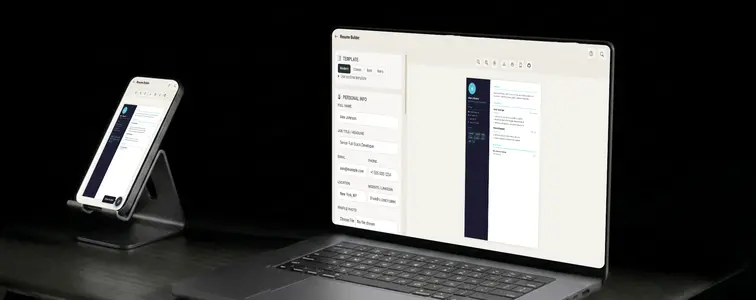
Recruiters do not read resumes. They scan them. The average first pass over a resume is counted in seconds, and the goal of that pass is not to admire your wording but to decide, quickly, whether you are worth a closer look. Everything you hear about resume design flows from that single fact: the layout has to carry the reader to the content, because nobody is going to hunt for it.
This is why the Resume Maker in MockupTown treats layout as a solved problem instead of a recurring one. You choose a template, fill in fields, and the document lays itself out as you go. No margin fights, no alignment surprises, nothing left to chance in a print dialog.
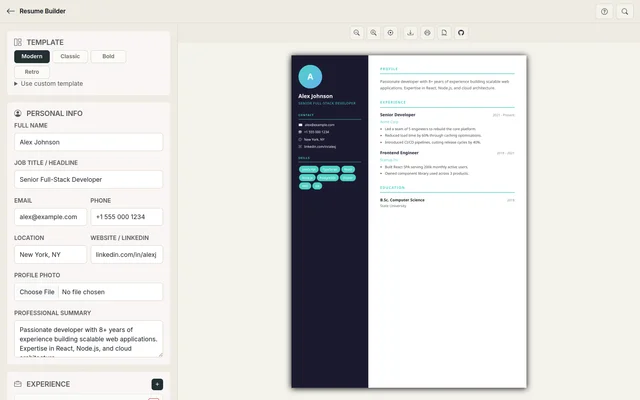 Structured sections on the left; the laid-out resume preview updates as you type.
Start with the impression you want to make
Templates are not interchangeable wallpaper. Each one makes a different promise before a single word is read:
- Modern reads current and clean, the safe default for most industries.
- Classic reads established and conservative, a fit for law, finance, and traditional firms.
- Bold reads confident, built for creative fields and design-forward companies.
- Retro reads distinctive, for roles where standing out is the point.
Pick the one that matches where you are applying. When in doubt, Modern or Classic, because the content is what actually wins the interview. The template just has to not get in the way.
Structure beats prose on a resume
A resume is a document where organization is the message. The generator gives you structured sections for a reason: every experience and education entry is its own block, addable and removable, with bullets under each. That structure matters more than any single sentence you write, because it is what lets a scanner or a tired recruiter find the important parts without effort.
Skills deserve a special mention. They render as tag pills rather than a comma-dense paragraph. When a recruiter or an application system is looking for a specific keyword, pills make it jump off the page. Mirror the language of the job posting in those pills, and the resume starts doing the filtering work for you.
The bullet point does the heavy lifting
Everything else in the resume is filling in facts. The bullets are where you earn the interview, and the pattern that works is embarrassingly simple: what you did, and what changed because you did it.
- "Managed a support team of six."
- "Managed a support team of six and cut average resolution time from 4 hours to 90 minutes."
Same job. One of those gets an interview. Numbers are the difference, because they turn claims into evidence. Every bullet can follow this shape, and if a bullet cannot, it probably does not belong on the resume.
A checklist before you hit print
- One page where possible. Complete beats exhaustive. Cut anything older than ten years that is not carrying current weight.
- Reverse chronological. Latest experience first. That is where the scan starts.
- Tailored per application. The resume that gets replies is the one written for the specific role, not the generic version.
- Proofread out loud. Errors on a resume are read as carelessness, and they are the most preventable mistake there is.
- Stay honest. Exaggerated roles survive the interview and die in the background check. The resume is your best honest self, not a fiction.
The Resume Maker covers the layout, the live preview, the PDF and PNG export, and it does it all without a signup. What it will not do is write the truth for you. But if the content is real, the document will finally look as good as the person behind it.
Made with MockupTown, the free all-in-one mockup generator.
Frequently asked questions
Is Resume Builder free to use?
Nothing to pay. Every feature this guide mentions works without a plan, a trial window, or an export cap.
Can I use the results commercially?
Cleared for commercial work from day one. Free exports carry exactly the same usage rights as Pro ones.
Do I need an account?
None. Identity, email, password: none of those words appear anywhere in the interface.
Can I print to PDF?
Yes - use the print control and pick Save as PDF as the destination in the dialog that opens.