
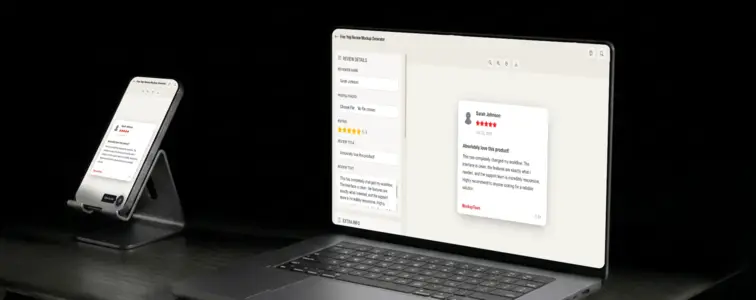
Yelp owns the local business review space. When someone searches for a restaurant, a barbershop, a dentist, or a dry cleaner, Yelp is the platform they check first. The red accent, the star rating, the business name, the reviewer photo. This visual language is deeply embedded in how people evaluate local businesses, and a review card in Yelp styling immediately communicates a specific kind of trust: the trust that comes from real people visiting real places.
That is what makes a Yelp review mockup valuable. When you need to show what a local business review looks like, or demonstrate a review feature for the hospitality industry, or create a landing page section for a restaurant or service business, the Yelp format is the one that most people recognise. The problem is that building a convincing Yelp review card by hand is tedious, because the details are specific and the design has a distinct personality. The Yelp Review Mockup Generator in MockupTown renders the actual layout, so your mockup looks like it was pulled straight from Yelp.
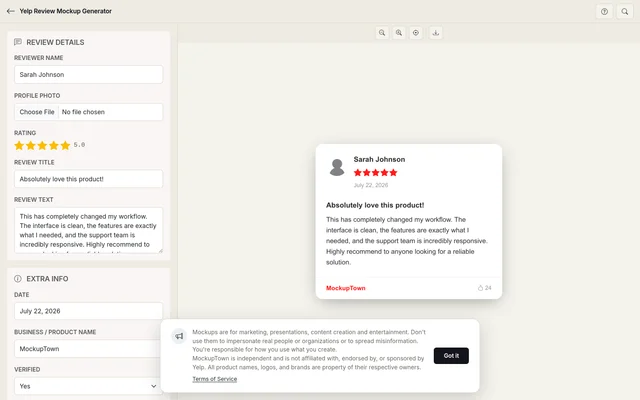 Yelp Review Mockup.
Why Yelp carries local business weight
Yelp is not a general-purpose review platform. It is the review platform for local businesses. When someone sees a review card in Yelp styling, they immediately think of restaurants, cafes, salons, and service providers. That association is so strong that the Yelp format has become the default for any business that relies on foot traffic and local reputation.
The design carries specific signals. The red accent is the most obvious one: it is the colour that appears in the Yelp logo, the star rating, and various UI elements throughout the platform. The reviewer photo is more prominent than on other platforms, because Yelp emphasises the individual behind the review. The business name appears in the review card itself, because the review is tied to a specific location. Each element works together to create a visual language that says "this is a real place, reviewed by real people."
The anatomy of a Yelp review card
A Yelp review card has a specific structure that the generator reproduces accurately:
- The reviewer profile at the top. Name, photo, and rating. Yelp puts the reviewer first, because the individual's opinion is the core of the experience.
- The star rating. Five red stars, displayed prominently next to the reviewer name. The red colour is Yelp's signature.
- The review date. When the review was posted. Yelp shows this as a relative date ("3 days ago") or an absolute date depending on the age.
- The review body. The main text of the review. Yelp reviews tend to be longer and more detailed than Google Reviews, because people write them after visiting a physical location.
- The business name. Yelp ties the review to a specific business, and the name appears at the bottom of the card. The thumbs-up counter beneath each review is another layer of social proof worth reproducing faithfully. This adds community validation.
Yelp's red runs through the design
Yelp's red is not just a colour choice. It is a brand identity. The red appears in the logo, the star rating, the review count, and various UI elements throughout the platform. When you see that specific shade of red in a review card, you immediately think of Yelp.
The generator uses the actual Yelp red, so your mockup matches the real platform. This consistency is what separates a convincing mockup from one that looks assembled. The red stars, the red business name, the red accent on the rating bar. Each element reinforces the brand identity.
The details that make it look like a real Yelp review
- Use the red star rating. Yelp's stars are red, not yellow. The generator handles this automatically, but it is worth knowing why it matters.
- Make the review detailed. Yelp reviews tend to be longer than Google Reviews, because people are reviewing a physical experience. A two-sentence review reads as thin on Yelp.
- Add a specific business name. Yelp reviews are tied to specific businesses. "The Italian Place on Main Street" reads as genuine. "A restaurant" does not.
- Use a real photo. Yelp emphasises the reviewer's identity. A real photo makes the review feel grounded.
- Set a realistic date. Yelp reviews are often posted within days of a visit. A recent date reads as current.
Where a Yelp review mockup earns its place
- Restaurant marketing. The most common use: showing what customers say about a restaurant in the format people actually use to find restaurants. The Yelp format is the industry standard.
- Hospitality presentations. Hotels, cafes, and service providers use Yelp review mockups in pitch decks and marketing materials to demonstrate customer satisfaction.
- Local business documentation. Guides about online reputation management for local businesses use Yelp mockups as examples.
- Blog posts. Articles about restaurant marketing, local SEO, or review management benefit from realistic Yelp visuals.
- Educational content. Business courses that cover local marketing and customer feedback use Yelp mockups to teach platform-specific concepts.
Keep this in mind: is important: review mockups are for presenting your own work and demonstrating platform layouts. Using them to fabricate customer feedback for a real business crosses a line that is not worth crossing. Render an illustrative review, not a copy of a genuine customer's writing.
Building a Yelp review card in two minutes
Open the Yelp Review Mockup Generator, enter the reviewer name, star rating, review title, and review text. Add a date, business name, and optional helpful count. Upload a profile photo or use the default avatar. Export as a high-resolution PNG. Your data never leaves the browser.
The generator uses the actual Yelp review layout, with the red star rating, the correct typography, and the faithful spacing. The result looks like a screenshot from a real Yelp business page, not a hand-built approximation.
When your project needs a Yelp review visual, you can build the exact card instead of describing one in text. Open the Yelp Review Mockup Generator, set the details, and export a mockup that looks like it belongs on the actual platform.
Made with MockupTown, the free all-in-one mockup generator.
Frequently asked questions
Does this tool scrape real Yelp reviews?
No. Everything is typed into the editor and rendered locally in your browser. No data is pulled from Yelp's servers.
What does the Elite badge look like?
The Elite badge appears as a small icon next to the reviewer's name.
Can I show the "Useful / Funny / Cool" vote counts?
Yes. The mockup includes vote count fields for each of the three categories, displayed below the review text just as Yelp shows them.
Can I add business category labels?
Yes. Select a category like "Restaurants" or "Home Services" and the mockup displays it next to the business name, matching Yelp's layout.